
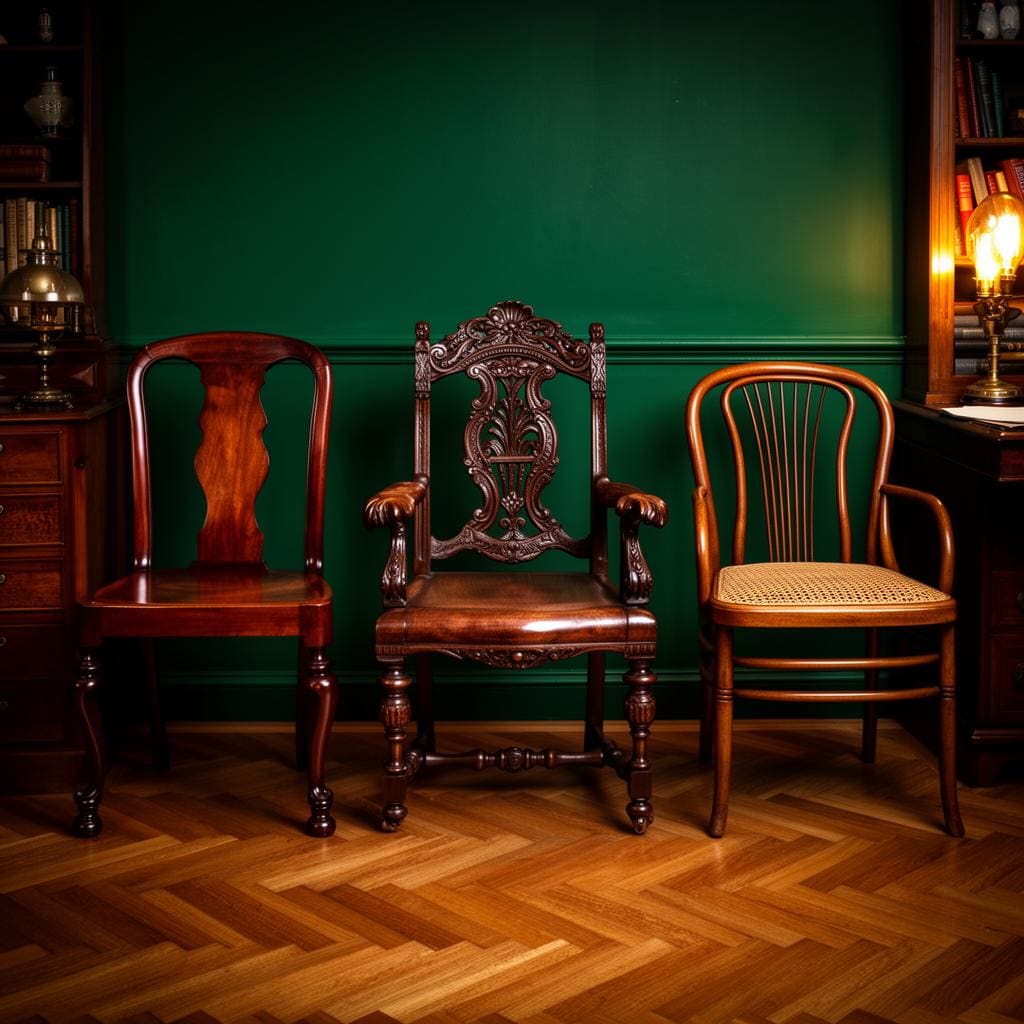
Opening scene
Picture three chairs lined up side by side. One Georgian. One a Victorian reproduction made in the 1880s. One a 1920s revival made to look as though it came from 1720. Which one is the oldest?
Most people get it wrong, and that's the hook for this entire lesson. Dating antiques is not about how old something looks. It's about how old something actually is. Those are two very different things.
Introduction
One of the most common things people say when they bring me an antique is, "I think it's really old." The problem is that "old" isn't a date. And in this trade, dates matter, a lot.
A piece made in 1780 and a piece made in 1880 can look remarkably similar. A piece made in 1920 may have been designed deliberately to look as though it came from 1720. If you buy based on appearance alone, sooner or later you'll make an expensive mistake.
The good news is that professional dealers don't rely on instinct. They follow a process, and this lesson is that process.
1. The biggest myth in antiques
Experts don't know instantly. They have a system.
Television creates the illusion that experienced valuers recognise everything on sight. They don't. What they have is a method. The best dealers gather evidence first and build conclusions afterwards. Dating is not guesswork. Dating is investigation.
2. The antique detective mindset
Imagine you're a detective arriving at a crime scene. You don't decide who committed the crime immediately. You gather evidence, check for contradictions and only then form a conclusion. Dating antiques works in exactly the same way. Every object leaves clues, some obvious, some hidden. The job is learning how to spot them.
3. The three pillars of dating
Style
What it looks like
The visual language of its period, proportion, decoration, silhouette.
Materials
What it's made of
Timbers, metals, dyes and finishes each appeared or disappeared at specific dates.
Construction
How it was made
Joinery, tools, fixings, the techniques available to the maker at the time.
These three pillars are the backbone of every confident date. One on its own is suggestive. Two agreeing is strong evidence. All three agreeing is usually conclusive.
4. Pillar one, style
Every period has a visual language. A few of the major ones:
Georgian elegance
Restraint, classical proportion, slender legs, fine inlay. Confidence through symmetry.
Victorian abundance
Heavier proportions, deep carving, dark timbers, ornament for its own sake. A new middle class showing off.
Arts & Crafts honesty
Visible joinery, native timbers, hand-finished surfaces. A reaction against industrial mass production.
Art Nouveau curves
Whiplash lines, floral motifs, asymmetry. Nature reinterpreted as decoration.
Art Deco geometry
Streamlined, exotic veneers, chrome, lacquer. The optimism of the machine age.
Don't just memorise the names. Understand why each style existed and what its makers were reacting against. Style memorised is forgotten. Style understood is permanent.
5. The Georgian trap
Place a genuine Georgian table next to an 1880s Victorian "Georgian revival" and a 1920s reproduction. To an untrained eye, all three look Georgian. Style alone won't separate them. This is the moment every student of antiques realises the same thing: style is the first pillar, never the only pillar.
6. Pillar two, materials
Materials rarely lie.
A style can be copied. A material timeline is much harder to fake. Certain materials simply didn't exist before a certain date, and once you know those dates, they become hard boundaries.
- Aluminium in any quantity → post-1880s.
- Aniline (synthetic) dyes → post-1856.
- Plywood as a structural material → late 19th century onwards.
- Bakelite and early plastics → 20th century.
- Machine-cut, paper-thin veneers → late Victorian onwards.
7. The material time machine
1700s
Pre-industrial
Hand-sawn veneers, oak and walnut, natural dyes, hand-forged fittings.
1800s
Industrial
Mahogany, rosewood, machine saws, early plywood, aniline dyes after 1856.
1900s
Modern
Aluminium, Bakelite, chrome, formica, mass-produced screws and fittings.
Today
Synthetic
MDF, modern plastics, laser-cut joinery, instantly recognisable on close inspection.
8. Pillar three, construction
How was it made? Many beginners never ask. Yet construction is often the single strongest clue available. The maker had only the tools and techniques of their time. Those tools left fingerprints.
9. The dovetail lesson every dealer learns
Hand-cut dovetails
Slightly irregular spacing. Subtle tool marks. Pin sizes vary. The work of a craftsman, not a router.
Machine-cut dovetails
Perfectly even, identical spacing, sharp uniform pins. A reliable sign of post-1860 manufacture.
Pull a drawer out and look at the joints where the front meets the side. This single check can change your date by a century.
10. Screws tell stories
It sounds boring. It's actually fascinating. Hand-filed screws of the 18th and early 19th century have off-centre slots, irregular threads and slightly tapered shanks. Machine-made screws from the mid-19th century onwards have perfectly centred slots and even threads. A screw is sometimes a more reliable witness than the furniture it holds together, because nobody bothers to fake a screw.
11. When the evidence doesn't agree
Style says 1780. Materials say 1900. Construction says 1920. Now what?
This is exactly what dealers face every day. Conflicts are not failures, they're clues. They usually mean one of three things: the piece is a later reproduction in an earlier style, the piece has been heavily restored, or the piece is a marriage of parts from different eras. Each of those carries a very different value.
12. The restoration problem
Many genuine antiques contain new handles, new locks, new upholstery, replaced feet or new screws. That doesn't automatically make them fake. But you do need to know the difference between three very different categories:
Restoration
Sympathetic repair to keep the piece in use. Original character preserved. Often accepted by the trade.
Alteration
The piece changed in size, shape or function. Significantly affects value.
Reproduction
A later copy made to look earlier. Not an antique, even if it's beautifully done.
13. The most expensive mistakes dealers make
- 1.Trusting style alone, the easiest pillar to fake.
- 2.Ignoring construction, the hardest pillar to fake.
- 3.Ignoring restoration, paying antique prices for replaced parts.
- 4.Dating from memory, even great dealers reach for the books.
- 5.Failing to compare, one piece in isolation is opinion, two pieces side by side is evidence.
14. The secret weapon, comparables
This is where professionals gain real confidence. You verify your conclusion against pieces with a known date. Four reliable sources:
Two or three good comparables will tell you more than a hundred guesses. Opinion is cheap. A documented parallel is gold.
15. A real case study
A small mahogany side cabinet arrives on the bench. We work it through the system, slowly.
- Style: Late Georgian, slim proportions, restrained inlay, brass swan-neck handles.
- Materials: Solid mahogany carcass, oak drawer linings, no plywood anywhere, consistent with pre-1840.
- Construction: Hand-cut dovetails, slightly irregular. Hand-filed screws, off-centre slots.
- Comparison: Matches three documented examples in a Christie's catalogue from 2014, dated c.1810.
- Conclusion: Circa 1810. High confidence. Two replaced handles, otherwise original.
16. Building a date range
Most beginners want a single year"It was made in 1787." Professionals usually think in ranges"Circa 1780-1800." A range is more realistic, more honest and almost always more useful. The only people who deal in single years are the people who don't yet know how much they don't know.
17. Confidence levels
High confidence
All three pillars agree and the comparables match. You can stake your reputation on the date.
Probable
Two pillars agree, the third is ambiguous. Date stated with a caveat.
Tentative
Conflicting evidence or limited comparables. Date offered as an opinion only.
Certainty is a spectrum. Great dealers are clear about where on that spectrum any given conclusion sits.
Practical exercise
Take any three objects in your own home and walk them through the system:
- 1.Assess style, what period does it belong to visually?
- 2.Assess materials, what is it made of, and when did those materials become common?
- 3.Assess construction, joinery, fixings, tool marks.
- 4.Compare, find at least two documented examples online or in books.
- 5.Create a date range, not a single year.
- 6.Assign a confidence level, high, probable or tentative.
Now you're doing what dealers do.
Final thoughts from Eric
The best dealers aren't the people with the best memories. They're the people who ask the best questions. Every antique leaves clues, the challenge is learning which clues matter.
Style tells part of the story. Materials tell another. Construction often reveals the truth. Bring all three together, and dating stops being guesswork and starts becoming evidence. Once you can date accurately, you're no longer looking at antiques the way most people do, you're seeing them the way professionals do.
Key takeaways
- Dating is investigation, not instinct.
- Style, materials and construction are the three pillars.
- Style is the easiest pillar to fake, always check the other two.
- Hand-cut dovetails and hand-filed screws are reliable pre-1860 indicators.
- Conflicting evidence usually means restoration, alteration or reproduction.
- Comparables turn opinion into evidence.
- Think in date ranges, not single years.
- Be honest about your confidence level on every conclusion.
Questions About This Lesson?
Leave a comment, ask Eric a follow-up question, or suggest a future lesson. Approved comments appear below to help the wider learning community.